
Discuss the Contemporary Necropolitics in Calais with close analysis on the writings of Achille Memb
- Dec 17, 2016
- 12 min read
Necropolitics is the relationship between sovereignty and power over life and death. Within this essay I will discuss the workings of necropolitics in relation to the contemporary migrant crisis in Calais. I will discuss the migrants in terms of the problems surrounding their visibility and living conditions and argue from this point of view that their contentious life status under the sovereign, necropolitical power of violence and disposability, and their potential choices in the matter, are illusion. The philosophies of Achille Mbembe in his essay entitled ‘Necropolitics’ conclude that this political power induces a condition of ‘living death’ towards it’s victims. In addition, the writings of Michel Foucault on biopower and sovereignty, as well as those of Hannah Arendt, Enzo Traverso, Giorgio Agamben and Eyal Wizeman, will substantiate this argument by covering themes regarding racism, dehumanization and stereotyping.
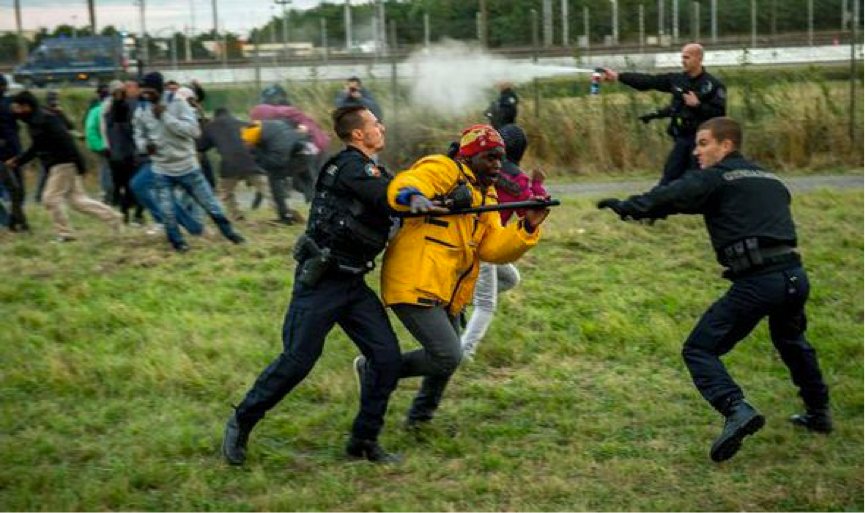
Achille Membe has defined ‘the notion of necropolitics and necropower to account for the various ways in which, in our contemporary world, weapons are deployed in the interest of maximum destruction of persons and the creation of deathworlds, new and unique forms of social existence in which vast populations are subjected to conditions of life conferring upon them the status of living dead’[1]. This underlines how the state of sovereignty is practised to determine the disposability of people’s lives. Membe pinpoints, ‘to exercise sovereignty is to exercise control over morality and to define life as the deployment and manifestation of power’[2]. This is seen undeniably with the state control over the migrants in Calais in how their lives’ have been reduced to an existence solely for the means of survival. In the modern world biological life isn’t sufficient to classify as ‘having a life’; we would expect, these days, to also have a basic quality of life, which includes some set of human rights, food, shelter and some sense of civil liberty. For example we have condemned regimes which champion slavery or incarceration such as Nazi Germany for human rights violations, but this clearly is not the case in Calais, as demonstrated by the police’s use of teargas and violence to remove migrants in the demolishment of the Southern section of the camp in March this year (figure1).
Migrants have actively chosen to leave their country (due to them being rife with war such as Syria, Iran, Afghanistan, Saudi Arabia, Pakistan and Libya) but have now, by default, made a passive decision to be in France because they were not allowed to cross the boarder to England. Arguably now they might be stateless but according to the state they’re subject to French law whilst on French territory, regardless of the fact that they don’t have citizenship or refugee status. This means in legal terms they have the potential to commit crimes and be punished accordingly despite no official consent. In other words they can be named as criminals but, due to their lack of citizenship, they cannot call on their civil rights to support themselves, which is highly contentious. This brings to question who is subject to this right and ‘under what practical conditions is the right to kill, to allow to live, or to expose to death exercised’[3], in our contemporary society?
Figure 1: Police use violence and teargas against the migrants, in the demolishment of the Southern part of the camp in March 2016.
To understand necropolitics properly we have to go back to the foundations of biopolitics and power. Biopower works through a secular morality through which people in power are able to justify murderously conclusive actions. This is justified by input vs. productivity. Biopolitics is the unquestioned policing of individuals based on economic worth. This dehumanizes individuals; people are viewed by how much value they produce in terms of the economy. So, one’s morality is measured by how many working hours they commit to and if they are willing to chase the idealistic idea of freedom through selling their time to a job, exemplifying them to be buying into neoliberalism. This allows the system to monitor where people are located on a daily basis and how susceptible they are to diseases, which allows biopower to profit but can lead to the fracturing of community and family relationships.
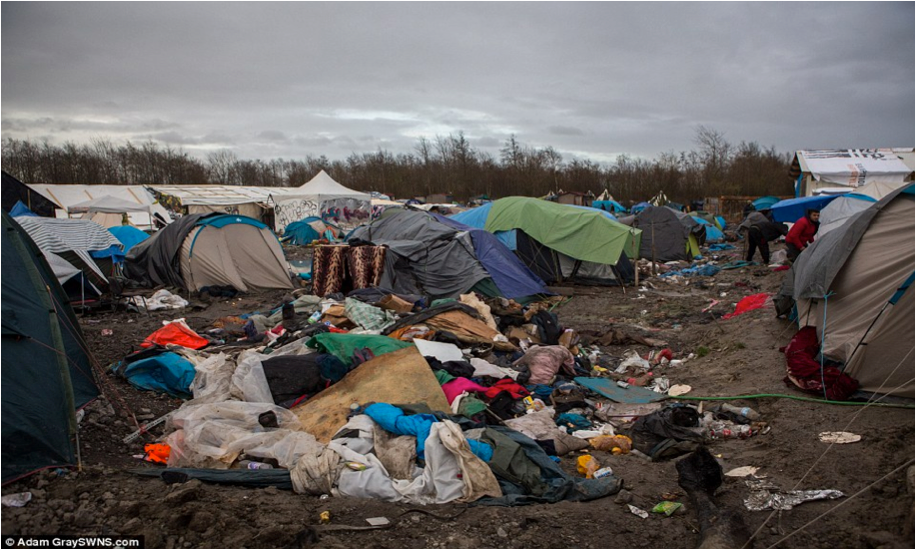
Biopower deals with those who dissent to this regime by isolating them. If resistant they are labelled as insane, often leading them to be institutionalised and incarcerated under the prison system. This supports Michel Foucault’s theory that biopower is ‘that domain of life over which power has taken control’[4]. With this in mind one understands necropolitics as an extreme version of biopolitics in which individuals are denied life to the point of almost, ‘living dead’[5]. Membe supports this stating ‘the notion of biopower is insufficient to account for contemporary forms of subjection of life to the power of death.’[6] This bleak existence underlines how the justification of biological life is not enough, for this enslavement and manipulation of control does not constitute living. This is seen clearly in the influx of millions of migrants seeking new lives in Europe but being imprisoned and controlled upon the French border to England, living in futile, disease riddled conditions, under the biopolitical and necropolitcal power of the French state. The Guardian labelled the conditions in the camp to be ‘diabolical’, ‘with cramped makeshift tents plagued by rats, water sources contaminated by faeces and inhabitants suffering from tuberculosis, scabies and post-traumatic stress’[7] (see figure 2 and 3.) Further supported by a migrant’s statement on BBC Newsnight; ‘It’s very hard for us but how can we change. There is no solution’.[8] This treatment arguably labels them as inadequate to the rest of humanity due to their lack of citizenship, inferring the presence of stereotyping and racism within the necropolitical field.
Figure 2: Smoke from the burning rubbish, rising alongside a queue of migrants waiting for food.

Figure 3: The squalor of the ‘Calais Jungle’; cramped tents alongside built up dirt and rubbish.
‘Race has been the ever present shadow in Western political thought and practice, especially when it comes to imagining the inhumanity of, or rule over, foreign people’s’[9]. This ultimately stems from the foundations of enmity towards particular groups within society or in this case, migrants, whose visibility within society is a subject breached by humanitarians’ for their human rights as they are often given no recognition. This contemporary problem of visibility is brought to recognition in Luca Guadagnino’s film ‘A Bigger Splash’, 2015 starring Tilda Swinton and Ralph Fiennes. Guadagnino references the migrants in a scattering of several shots during the film giving them no real story line, underlining their unrecognised human status. The film shows 4 white privileged protagonists on the Italian Island of Pantelleria (Figure 4 and 5), demonstrating careless and destructive behaviour in juxtaposition to the migrants. This underlines the sheer depravity of the migrants who solely seek sanctuary and a means to get by, reinforcing that biological life is not enough to constitute living.
Figure 4&5: The 4 main characters of, ‘A Bigger Splash’, 2016,
,Tilda Swinton, Dakota Johnson, Ralph Fiennes and Matthias Schoenaerts on the Italian island of Pantelleria off the Sicilian coast.


Biopower and a rooted sense of hierarchy are undeniably linked in relation to sovereignty’s alleged right to kill within Necropolitics. Foucault’s theory of biopower refers to how its field can control and separate people into specific groups of who should stay alive and who should die, the control presupposing ‘the subdivision of the population into subgroups and the establishment of a biological caesura between the ones and the others’, which he defines with the title ‘racism’[10]. It is important to note here that whilst this still very much applies, this modern example expands this theory, incorporating more sociological sub-definitions of humans; religion and economic value are now the buzz-words used by the State and the media to separate these people from the Western demographic, whose collective “blind-eye” plays a pivotal role in the systematic subjugation of the migrants. This institutionalised racism and stereotyping of minority groups underlines the illusion of choice they have over their livelihood under the power of sovereignty, for indeed they have passively chosen to be where they are but they are then subjected to violence under the terms of the state. This is supported by the German sociologist Max Weber who defines the state as a “human community that (successfully) claims the monopoly of the legitimate use of physical force within a given territory.’[11] This is exemplified in Calais in their confinement to the camp and the policing and tall fencing around its edges (Figure 6) and the subsequent use of teargas on its occupants. This lack of choice is further supported by Guadagnino’s scene, in ‘A Bigger Splash’, when the well-groomed protagonists head to the police station being treated with the utmost respect whilst opposite the migrants are fenced into a little compound waiting to hear their fate. This brings us to pose the question as to why people are subjected to this treatment when we are all humans with supposedly equal rights. Within the notion of necropolitcs, however, ‘politics of race is ultimately linked to the politics of death’[12].
Figure 6: ‘The Calais Jungle’ against the imposing fences to the route to the boarder.

This political rooting of the power of sovereignty underlines the purpose of racism to be to solely the control of the allocation of death, which opens up the feasibility of a furious and arguably lethal state. Foucault indicates it to be ‘the condition for the acceptability of putting to death’[13]. This can be seen throughout events in Modernity predominantly in the creation of the Nazi state, which saw its formation after Hitler was elected as chancellor in 1933. This state saw the practice of sovereignty over people’s lives, exemplifying people living a merely functioning existence, under regimented control within the concentration camps of the Holocaust (figure 7). The Nazi state in the late 1930’s laid the foundations for ‘a formidable consolidation of the right to kill, which culminated in the project of the ‘Final Solution’, as Membe highlights, creating an ‘archetype of power formation that combined the characteristics of the racist state, the murderous state and the suicidal state’.[14] This highlights the death-like status that the minority groups such as the Jews, homosexuals and disabled suffered. The most famous concentration camp was Auschwitz, located in Poland, which used gas chambers as a form of extermination and from May 1940 to late 1944 prisoners were sent there straight to their deaths or to live and work within the camps conditions, as Membe evaluates, ‘conferring upon them the status of living dead’[15]. Auschwitz alone recorded the death of 1.1 million Jews; the system dehumanized its occupants as Enzo Traverso pinpoints - ‘the gas chambers and the ovens were the culmination of a long process of dehumanizing and industrializing death, one of the original features of which was to integrate instrumental rationality with the productive and administrative rationality of the modern western world’[16]. This made death within the sovereign power of the state a ‘mechanized’ and ‘rapid procedure’[17], stemming from the victimisation of people upon stereotypes and class based racism, which saw, as Enzo Traverso indicates, the comparison of ‘working classes and stateless people of the industrial world to the savages of the colonial world’[18]. This is mirrored in both the past treatment of the Jews in the concentration camps and contemporary treatment of the migrants in Calais. The migrants are stripped of all human rights and sleep like animals. As one of the migrant quotes, ‘this Jungle from everywhere people live; people, humans, not animals’[19] (Figure 8).
Figure 7: Jewish Children behind a barbed wire fence at the Nazi concentration camp at Auschwitz in Southern Poland.

Figure 8: A young migrant child amid rats, mud, rubbish and tents in the ‘Calais Jungle’

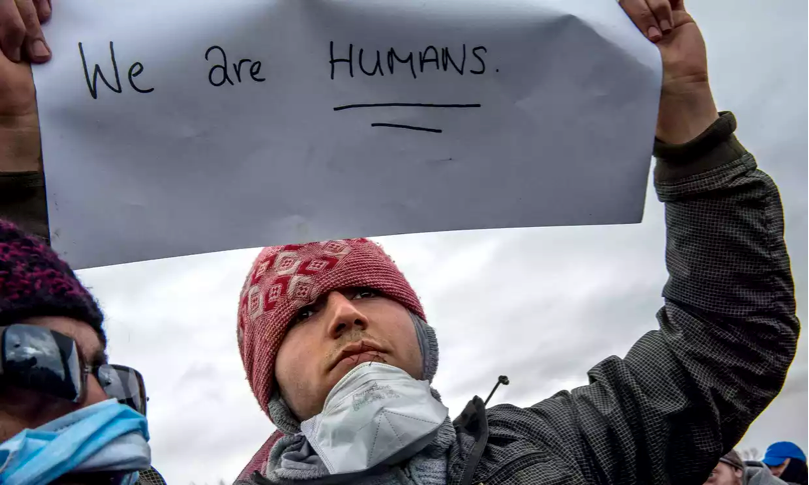
Membe, refers to death camps as ‘the central metaphor for sovereign and destructive violence and as the ultimate sign of the absolute power of the negative’[20]Giorgio Agamben further reinforces this stating it to be ‘the place in which the most absolute condition in humans ever to appear on Earth was realized’[21], indicating the control and power necropolitics and sovereignty have over the migrants as they have the ability to decide whom, as Membe indicates, ‘matters and who does not, who is disposable and who is not’[22]. The desperation in Calais lead to migrant’s protesting against the forthcoming eviction from their homes in ‘the Calais Jungle’ on the 2nd March, by sewing their mouths together. Around 6 Iranian men sewed their mouths together, whilst they watched the police with bulldozers destroy homes within the camp. They did this as the Mirror states, ‘ to signify that their voice’s are not being heard by the French authorities’, underlining their lack of visibility and choice over their own futures. The men were pictured as seen in Figure 9, holding ‘aloft banners accusing the officials of restricting their freedom and their human rights’. One of the signs read ‘I left my country and came here to find my human rights but unfortunately I have none’.[23]Hannah Arendt supports this stating that there are ‘no parallels to the life’ in camps of these conditions; ‘its horror can never be fully embraced by the imagination for the very reason that it stands outside of life and death’[24].
This reinforces Membe’s evaluation of necropolitcs subjecting people to a death like state, for ‘in the political- juridical structure of the camp’ he adds ‘the state of exception ceases to be temporal suspension of the state of law’[25]. This underlines the migrant’s lack of choice, completely refuting the Hegelian theory that under necropolitics, ‘human death is essentially voluntary, due to risks consciously assumed by the subject’[26].
Figure 9: An Iranian migrant protestor with his lips sewn closed.
With this in mind, one understands that violence and sovereignty here come hand in hand. The statelessness of peoples’ identity opens up a door for destructive violence and unexplained deaths, under the politics of necro and biopower. The demolishment of the southern section of the ‘jungle’, disposed of 4,000 of peoples homes, which caused huge animosity and violence among the migrants (figure 10). 400 of this 4,000 were recorded to be unaccompanied teenagers and children, many of which are now not accounted for. Their fate is not being recorded or known but one understands many have been trafficked, taken risks to get on to lorries or died of diseases rife in the camp such as scabies or bronchitis. This underlines the inhumane visibility and justice of rights these migrants hold under necropolitics; ‘according to Europol, 10,000 out of an estimated 26,000 unaccompanied child and teenage refugees in Europe have gone missing as a result of the refugee crisis’.[27]
Figure 10: Desperate migrants force themselves against a steel barrier, watching the Police organise the demolishment of their part of the camp in Calais.

Figure 11: Bulldozers being used to clear the makeshift settlement.

Furthermore, the connection between space and sovereignty is remodelled under the action of territorial fragmentation. This is, as Membe defines, ‘the sealing off and expansion of settlements’, with its purpose encompassing two parts, ‘to render any movement impossible and to implement separation along the model of the apartheid state’.[28]. This is clearly seen in the demolishment of the southern part of the ‘Calais Jungle’ and the controlled policing and fencing along the outskirts. This evidence is supported by Wizeman’s evaluation that ‘settlements could be seen as urban optical devices for surveillance and the exercise of power’[29]. This creates, as Membe states, a ‘a division between two nations across a boundary line’[30], in which the French state holds precedence.
Vertical sovereignty, as coined by Weizman, undeniably links to violent tendencies. This can been seen in the demolishment and the violent tactics taken by the police, through teargasing and physical force (figure 12&13). The French government falsely promised the week before that they wouldn’t be using bulldozers to carry out the procedure, however brutality was very much present and the police came in full force, armed, burning peoples’ homes. It exemplifies, as Membe states, ‘an orchestrated and systematic sabotage of… the urban infrastructure network’[31].
Figure 12: The Police provide armed back up for the demolition team against the migrants in March 2016.

Figure 13: Teargas being used against the migrants in the demolishment of the southern section of the camp.

To conclude, the migrant crisis in Calais shows that necropolitics is still alive today in contemporary society. If things progress in this downward spiral, in which there is no transparency in communication between the state and migrants under the field of necropolitcs, then violence will at some point accumulate in war. Due to the desperation of the migrants and their lack of autonomy, no visibility and no rights, the camp is, as Membe states, ‘not a community if only because by definition, a community implies the exercise of the power of speech and thought.’[1] By unintentionally employing this out-dated violation of human dignity known as necropolitics, the Western world risks condemning itself as another scar on the history of human dignity. The State-actors in this situation have already, by trying to minimalise attention to this humanitarian crisis, escalated the violence and brought it much “closer-to-home”. It should be brought to attention that humanity and solidarity are the only real answer to this issue – necropolitics has time and again proven to be incorrigible and brutal. Whilst simultaneously condemning past actions in violent State-population relations, Europe is well on the way to reinforcing these unsanctionable conditions. Simply put, it seems the ‘democracy’ of today only stretches as far as the eye can see, and is absolutely curtailed by non-conventional conditions such as the current “War on Terror”.
Figure 14:Migrants, trying to jump the fence, to jump onto lorries to reach England.

[1] Achille Membe, Necropolitics,(New York: Duke University Press, 2003), 40.
[2] Membe, Necropolitics, 12.
[3] Membe, Necropolitics, 12.
[4] Michel Foucault, Il faut defendre la societe, (New York: St Martins press, 2003), 213-4.
[5] Membe, Necropolitics, 40.
[6] Membe, Necropolitics, 12.
[7] ‘Calais Refugee Camp’, ‘The Guardian’, accessed April 20, 2016, http://www.theguardian.com/world/2015/oct/02/calais-refugee-camp-conditions-diabolical-report-jungle-bacteria-hygiene
[8] ‘Migrant Crisis’, ‘BBC Newsnight’, accessed April 19, 2016, https://www.youtube.com/watch?v=YYyaFtX35hU
[9] Membe, Necropolitics, 17.
[10]Foucault, Il faut defendre la societe, 57-74.
[11] Austin Sarat, Jennifer L. Culbert, States of Violence: War, Capital Punishment, and Letting Die, (Cambridge: Cambridge University Press, 2009),25.
[12] Hannah Arendt, The Origins of Totalitarianism,(New York: Harvest, 1966), 157.
[13] Membe, Necropolitics, 40.
[14] Membe, Necropolitics, 17.
[15] Membe, Necropolitics, 40.
[16] Membe, Necropolitics, 18.
[17] Membe, Necropolitics, 18.
[18] Enzo Traverso, La Violence Nazie: une généalogie européenne, (Paris: La Fabrique Editions, 2002).
[19] ‘Migrant Crisis’, ‘BBC Newsnight’.
[20] Membe, Necropolitics, 12.
[21] Giorgio Agamben, Moyens sans fins. Notes sur la politique, (Paris: Payot & Rivages, 1995),50-51.
[22] Membe, Necropolitics, 25.
[23] ‘Desperate migrants sew their mouths together’, ‘Mirror’, accessed April 21, 2016, http://www.mirror.co.uk/news/uk-news/desperate-migrants-sew-mouths-together-7480333
[24] Arendt, The Origins of Totalitarianism, 444.
[25] Membe, Necropolitics, 12-13.
[26] Membe, Necropolitics, 17.
[27] ‘We cannot look the other way’, ‘Independent’, accessed April 21, 2016, http://www.independent.co.uk/voices/the-11-year-old-refugee-i-met-in-calais-has-gone-missing-a6966506.html
[28] Membe, Necropolitics, 27-8.
[29] Eyal Weizman, ‘The Politics of Verticality’, accessed April 20, 2016, https://www.opendemocracy.net/ecology-politicsverticality/article_801.jsp
[30] Membe, Necropolitics, 28.
[31] Membe, Necropolitics, 29.
[32] Membe, Necropolitics, 30.
E x


Comments